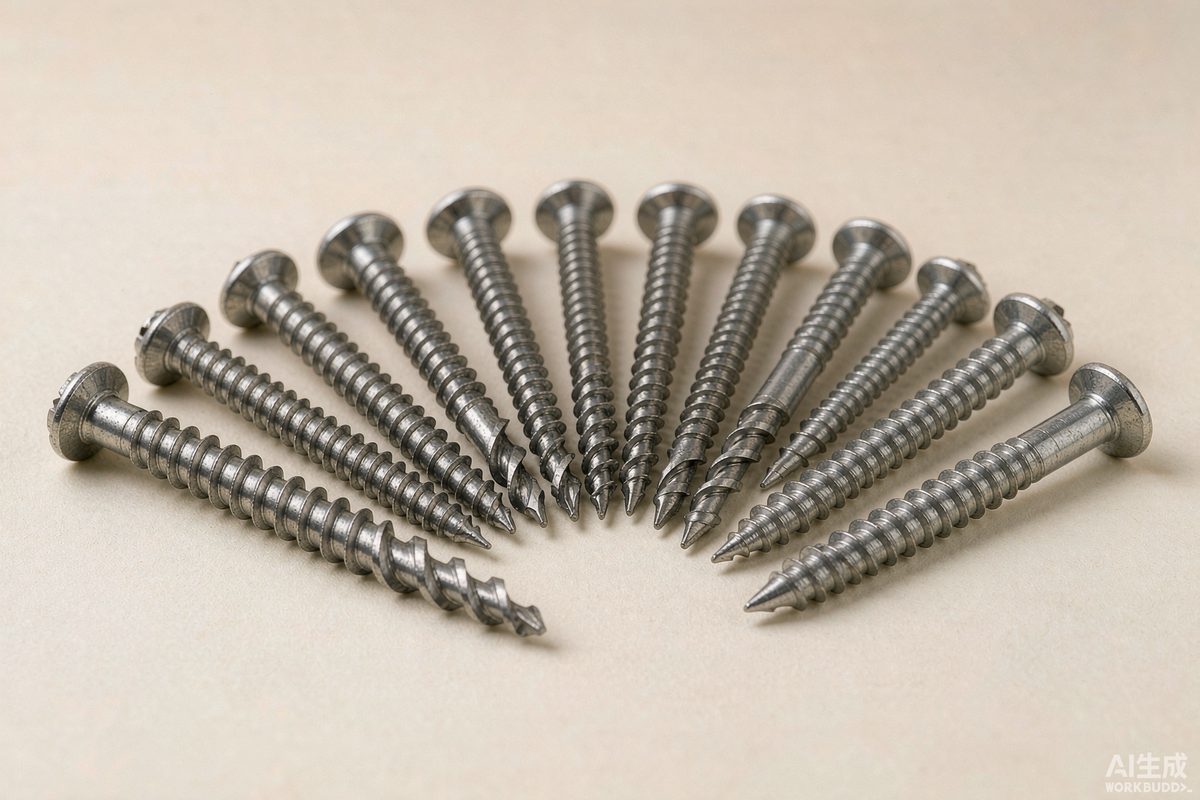
These two names are used interchangeably in purchasing, and the confusion costs real money: wrong screw, stripped holes, or a production line waiting for a drill. The distinction is simple once stated: a self-tapping screw cuts or forms its thread in an existing hole; a self-drilling screw has a drill-shaped tip that makes the hole as well.
1. Side-by-side
| Type | Needs pilot hole? | Common standard | Typical base material | Where used |
|---|---|---|---|---|
| Thread-forming (for metal) | Yes — sized hole | GB/T 845 / ISO 7049-type | Thin steel, aluminium | Sheet metal assemblies, enclosures |
| Thread-cutting (for plastic) | Yes | ISO 1481 / specials | Plastics, soft alloys | Housings, covers, electrical boxes |
| Self-drilling | No | GB/T 15856 · DIN 7504 | Steel purlin, sandwich panel | Roofing, cladding, steel framing |
| Self-drilling for wood | No | DIN 7505 | Timber, boards | Decking, crates, furniture |
2. Choosing self-drilling: it comes down to drill point number and thickness
Self-drilling screws are graded by the steel thickness they can drill — usually No. 1 to No. 5. Roughly: No. 2 up to about 2 mm of steel, No. 3 around 3 mm, No. 4–5 for 4–6 mm and heavier structural work. Choose by the total thickness being drilled, not by the top sheet alone — that is the mistake that leaves screws spinning halfway through.
3. Three failure modes and their causes
| Symptom | Cause | Fix |
|---|---|---|
| Screw spins, hole stripped | Pilot hole too large / material too thin / over-torqued | Reduce pilot size; increase diameter; use a rivet nut or backing plate |
| Drill point burns out, won't penetrate | Point number too low for thickness; high-speed steel vs stainless work | Higher point number; correct speed and pressure; consider pre-drilling |
| Head snaps during installation | Excess torque; screw hard but joint soft | Torque-limited driver; match screw hardness to application |
4. Material and coating for outdoor work
- Carbon steel, zinc plated — indoor or sheltered only.
- Mechanical zinc / Dacromet — the realistic choice for roofing and cladding; no hydrogen embrittlement risk.
- 410 / 304 stainless — long-life outdoor, but note stainless self-drillers wear the drill point faster and need more feed pressure.
- Bi-metal (stainless body + hardened steel drill tip) — the premium answer for thick or stainless substrates.
5. With EPDM washer or not
For roofing and cladding, always specify the bonded EPDM (or neoprene) washer. It seals the hole and prevents the "leak at every screw" complaint that shows up a season after installation.
6. What we supply
- Self-tapping: pan head, countersunk, hex washer head — steel, 304 / 316 stainless
- Self-drilling: No. 2–5 points, hex washer head, with or without EPDM washer
- Packed by size with clear part labelling for site use