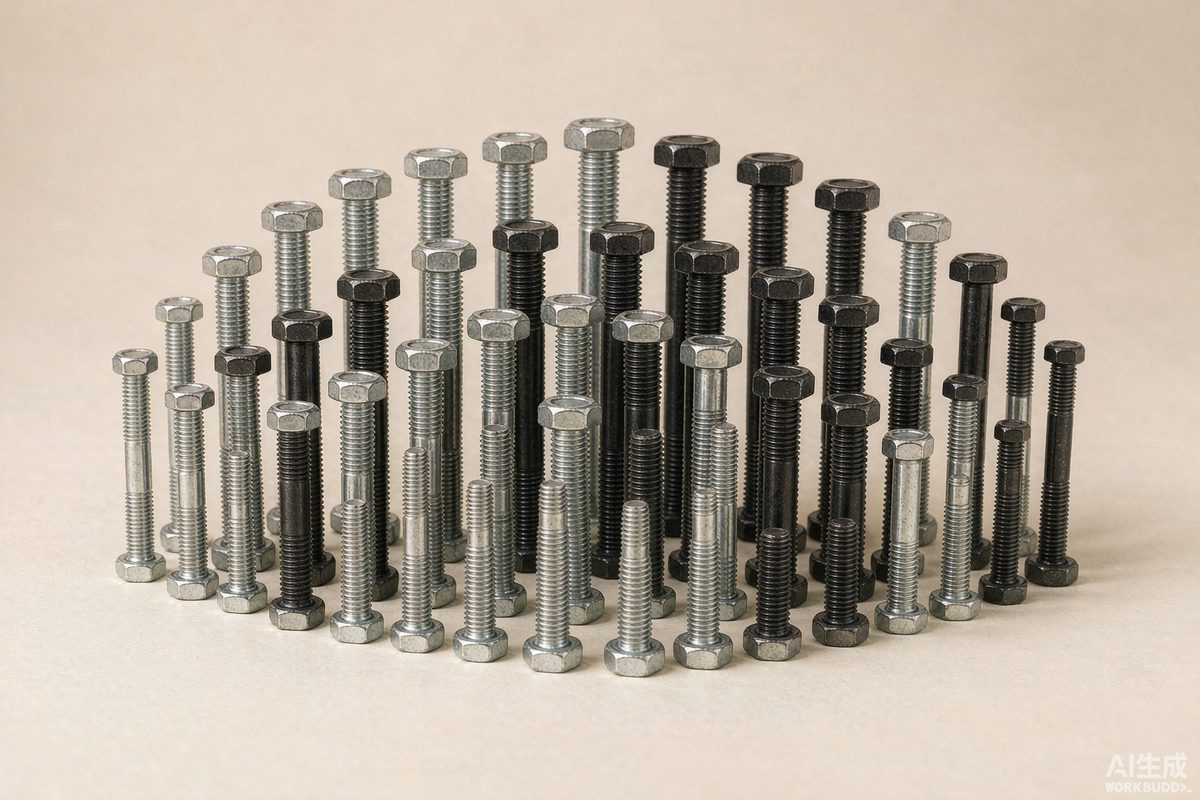
Stainless fasteners are bought either too optimistically (304 in a marine environment) or too expensively (316 where 304 would last the life of the machine). The decision is not about "stainless" in general — it is about chlorides, temperature and what happens at the thread interface.
1. Grades and what the markings mean
| Marking | Material | Tensile | Composition note |
|---|---|---|---|
| A2-70 | 304 austenitic | 700 MPa | 18 % Cr, 8 % Ni — general purpose |
| A2-80 | 304, cold worked | 800 MPa | Higher strength, slightly less ductile |
| A4-70 | 316 austenitic | 700 MPa | Adds ~2 % molybdenum — chloride resistance |
| A4-80 | 316, cold worked | 800 MPa | Marine + higher strength |
| C1 / C4 (410 / 420) | Martensitic | Up to 1100 MPa | Hardenable, less corrosion resistant |
Note the strength: A2-70 is about 700 MPa, below a carbon-steel 8.8 (800 MPa). Replacing 8.8 bolts with stainless one-for-one without checking the load is a classic design error.
2. When 304 is enough
- Indoor equipment, food processing areas with regular cleaning
- Urban outdoor with no salt exposure
- General machinery housings, control cabinets
- Freshwater and most chemical-process interiors
3. When you must move to 316
- Coastal / marine — salt spray is the classic chloride case
- Swimming pools, desalination, offshore
- Chemical plants with chlorides, sulphuric or phosphoric acid exposure
- Buried or splash-zone fixings
4. Two stainless problems that surprise buyers
| Problem | Why it happens | Prevention |
|---|---|---|
| Galling / seizing — nut welds to the bolt | Stainless oxide film breaks, cold-welds under pressure | Anti-seize compound, slower tightening speed, avoid re-using nuts |
| Crevice corrosion | Oxygen-depleted gap under the head or in the thread | Seal the joint, avoid standing water, choose 316 in chloride areas |
5. The magnetism question
304 fasteners are austenitic and essentially non-magnetic in the annealed state — but cold working (thread rolling, heading) induces some magnetism, so a magnet test is not a reliable way to confirm grade. If grade verification matters, request the material certificate and, if needed, a positive material identification (PMI) test.
6. Ordering checklist
- Grade: A2-70 / A4-70 / A4-80 — and standard (ISO 3506, DIN, GB/T)
- Form: bolts, socket cap screws, set screws, nuts, washers matched as a set
- Coating: usually none; consider PTFE or anti-seize pre-applied for galling-prone assemblies
- Certification: material certificate with heat number for critical service